1.
Developed with feedback from the wider community, the Seabird is the evolution of Mozilla Labs community member Billy May’s concept of what an “Open Web” mobile phone could look like. The two stand-out features from May’s vision are the integrated Bluetooth headset that doubles as a remote control and the dual pico projectors that can project a virtual keyboard as well as video or imagery. Other specs include an eight megapixel camera, a 3.5mm headphone jack, mini USB connectivity and wireless charging, which although available on Palm’s latest handsets, has not yet been widely adopted in the industry. Sadly, as part of Mozilla’s “Concept Series” there are no plans to put the Seabird into production, but the exciting elements from the design — the pico projection and the Bluetooth dongle (both technically possible today) — are features we could see more of in the future.

2.
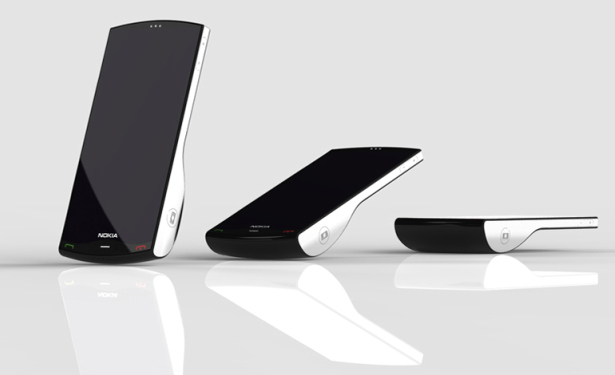
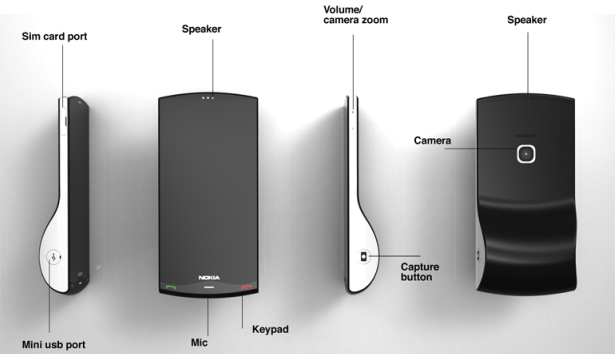
The Nokia Kinetic was design student Jeremy Innes-Hopkins’ answer to a Nokia-set brief for a “playful phone for 2012.” In addition to those curvaceous looks, the Kinetic offers the rather unusual ability of “standing up” when a call or text is received by “converting digital information into kinetic movement.” Under the hood, the “visual clue” of the phone standing up would be carried out by an electromagnet shifting a weight, while the same position could be employed for a video call or even watching media. Should you want to dismiss the “spontaneous, magical and undirected” alert, you could just gently push the phone to lie back down again. While we’ve no word on whether Nokia plans to put the Kinetic into motion (sorry!), we think that a visual cue for an incoming call sure beats hearing that tinny Gran Vals one more time.
 3.
3.
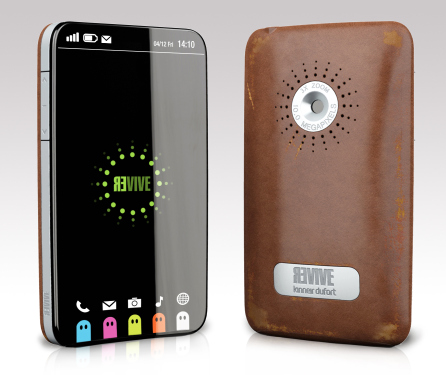
UK design and innovation company Kinneir Dufort came up with the “Revive” concept after working with the electronics remanufacturing specialists at Regenersis. The concept is simple: Many of us are tired of the excessive energy used and waste produced during the never-ending product cycles of the consumer electronics industry. The idea is that instead of trading in your old handset for a new one, you upgrade elements of your phone as they wear down (e.g. the battery) or as better parts become available (e.g. the camera). This way, says Kinneir Dufort, the system would allow “electronic products to keep pace with technological developments as well as consumer expectations.” To help encourage consumers to hold onto to their handsets, the materials used for the initial Revive handset would be ones that “become more beautiful with age” such as leather (as you can see in the image below) and it would boast what’s probably the world’s cutest graphical interface in order to help establish an emotional connection.
Additionally, a reward scheme would favor those that kept hold of their product for longer, while sophisticated diagnostics, remanufacturing methods and efficient logistics would take the hassle out of upgrades for the consumer. It’s a great concept for some kind of sustainability in the mobile phone market — “the phone that can only get better with age” — and we’d love to see a major manufacturer take up the idea. But while the majority of consumers still happily swap their gadget hardware every few years, the idea may be unlikely to get backing for some time.