
Every year, TreeHugger and all the architectural websites troll through theEvolo competition entries, looking for the most imaginative work from young architects with time on their hands. Sometimes you just have to shake your head and wonder at the creativity and drawing skills. In 2010, they did not pay a lot of attention to Bunker Arquitectura’s proposal for Earthscraper, an upside down pyramid in downtown Mexico City.

It was not a new idea, and it was not the best iteration of it that we had seen. But in two years, it has become a worldwide sensation. Emily Gertz at EcoImagination writes:
Earthscraper has become the architectural equivalent of a shot heard ’round the world. Since first surfacing this past summer on a handful of major design and tech blogs like archdaily.com, thetechnologyreview.com, and gizmag.com, this conceptual design for a 65-story, 82,000-square-foot inverted pyramid underneath Mexico City now commands over a quarter-million stories in diverse publications around the globe.
She spoke with Jeremy Faludi, who had some issues with the concept:
I think it would work much better in a dry area in a northern, colder climate, where solid ground keeps you warm, and the glass top acts as a greenhouse. In a hot climate, putting a building underground removes many ventilation opportunities—and you don’t want all that heat.
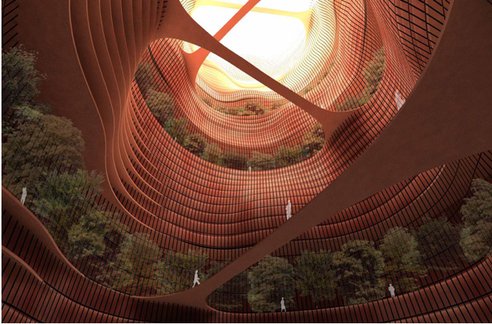
They discounted it at the time for some of the same reasons; while most people admired the density, They didn’t think it resolved the environmental issues. Also they remembered an earlier proposal from 2007 that had the same name, Earthscraper. and they thought, from an environmental point of view, was perhaps a bit better resolved:

Sunlight goes into the building through the central hole and a system of autoregulated mirrors induces complementary light into the depths. The circulation of natural air is forced through four suction nozzles that injects renewed air to the “green rings”.

But when it comes to resolving environmental issues, nobody comes close to Matthew Fromboluti, who has designed a skyscraper that seeks not only to hold a veritable society worth of people and uses, but simultaneously heals the scarred landscape of the desert outside of Bisbee, Arizona. His project, titled “Above Below,” proposes the infill of a 900-foot deep and nearly 300-acre wide crater left by the former Lavender Pit Mine with a structure that will hold living and working areas, and green space for farming and recreation.

He’s designed passive systems that work well in hot climates, including evaporative coolers and a solar chimney to create air circulation.

The land carved out by the Lavender Pit Mine is reclaimed by the desert, resembling its condition before the mine took place.